

“Judgment is the act by which the spirit affirms one thing over another; ‘God is good’, ‘man is not immortal’ are judgments since one affirms the goodness of God and the other rejects the immortality of man.” (CdF) Judgment is different from apprehension, since the latter involves conceiving an idea but the former involves saying that something is true or not true about the idea.
Jolivet continues: “Judgment necessarily encloses, then, three elements: a subject, which is the object of which something is affirmed or denied; an attribute or predicate [predicate is the most common term], which is what is affirmed or denied of the object [e.g immortality is denied of man]; [and] an affirmation or a negation.” (CdF)
Definition of a Proposition
Like the term is the verbal expression of an idea, the proposition is “the verbal expression of a judgment. It is composed, like judgment, of two terms, subject and predicate, and one verb called a copula… because it unites or separates the two terms.” (CdF) Jolivet goes on to explain that the copula is always the verb “to be”, taken only in the relative sense, which is to say does not presume that the subject exists. The only time when a judgment affirms or denies the existence of an object is in the types of propositions like “bread is that which exists”. Note that the predicate contains “that which” (abbreviated to “tw”). This is because the structure of the proposition used in philosophy — S (subject) is/are/is not/are not P (predicate) — does not tolerate a proposition like “bread exists”. This in turn is due to the structure of syllogisms and the relations between propositions, since it is easier to define laws when all the propositions are in a standardized form.
Kreeft defines when to use tw and “that which is” (twi) in one’s propositions. The goal is to convert the predicate to a noun. If the predicate is a verb, we use tw. If it is a adjective, we use twi. (SL)
In addition, it is worthwhile to discuss the differences between modern and Aristotelian views on propositions. According to Kreeft:
Modern logic texts look at it [propositions] in terms of extension, and of class inclusion. This is why they call simple propositions “categorical” propositions: because they relate two “categories” to each other. … in modern logic, any things in the world can simply be classified at will into mental boxes, and then those boxes are compared as to population (extension, not comprehension). Thus in modern logic “all men are mortal” means “the set of beings that we classify as men is included in the larger set of beings that we classify as mortals.” … in Aristotelian logic a proposition does more than that. It deals also with the real natures of things, our knowledge of these natures, and the expression of that knowledge and those natures in the meanings (comprehension) of terms. Thus “all men are mortal” means that all beings that have the essence of humanity have the property of mortality as part of that essence, or as a consequence of that essence. (SL)
Again, we see how Aristotelian logic aims to discover the real natures of things, whereas modern logic aims to manipulate things by placing them into arbitrary categories.
Types of Judgments and Propositions
Jolivet classifies propositions from four points of view: from the point of view of the form and matter; from the point of view of the quantity and the quality; from the point of view of the combinations of quality and quantity; and from the point of view of the relationships between the extension of universal propositions. (CdF)
Form and Matter
a) From the point of view of form. We can distinguish affirmative and negative judgments.
b) From the point of view of matter. We can distinguish analytic and synthetic propositions.
Analytical propositions are judgments in which the attribute [predicate] is identical to the subject (like in the case of the definition: “man is a rational animal”), essential to the subject (“man is rational”), a property1 of the subject (“circles are round”).
Synthetic propositions are judgments whose attribute [predicate] does not express anything essential or which is a property of the subject: “This man is old”, “The weather is clear”.2 (CdF)
Quantity and Quality
Quantity refers to whether the proposition is universal — covers all cases of the subject — or particular — covers only some cases of the subject. The quality of the proposition refers to whether the copula denies or affirms the predicate.
Combinations of Quantity and Quality
There are therefore four types of propositions:
(A) Universal Affirmative: All S is P
(I) Particular Affirmative: Some S is P
(E) Universal Negative: No S is P
(O) Particular Negative: Some S is not P
The letters beside the propositions denote them. According to Kreeft, they are derived from the vowels in the latin words affirmo (to affirm) and nego (to deny). (SL)
Relationships Between the Universal Propositions
a) In the affirmative (A), the subject is taken in its entire extension, but the predicate is taken only on one part of its extension: “Man is mortal” means that man is one of the mortals, which is to say one part of the mortal beings.
b) In the negative (E), the subject and the attribute [predicate] are both taken in their whole extensions: “No man is a pure spirit” means that man is not any of the pure spirits. (CdF)
Relations Between Propositions
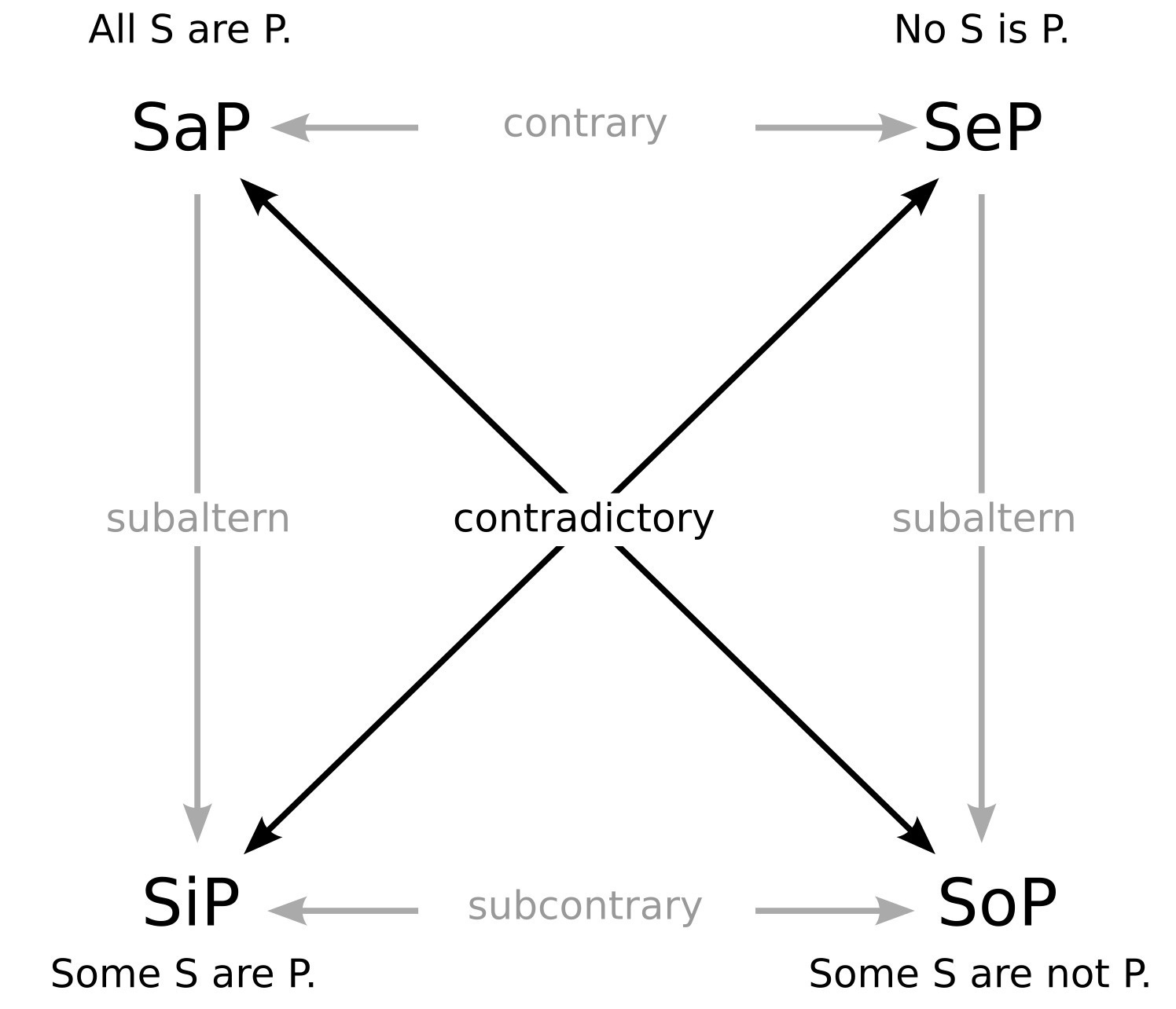
Jolivet defines opposition as “the relation between two propositions, which, having the same subject and the same predicate, have one quality or quantity that is different, or, at the same time, a quality and a quantity that are different.” (CdF) The concept of opposition is how you get the famous square of opposition shown above, where the relationship between each type of proposition is clearly delineated.
Contradictory Propositions
Contradictory propositions differ “in both quantity and quality”. (CdF) There are two pair of contradictory propositions: A and O, and E and I. Each pair cannot both be “true and false. If one is true the other is necessarily false”(CdF), and vice versa.
Contrary Propositions
Contrary propositions differ in only quality and refer to the two universal propositions: A and E. Two contraries “cannot be true at the same time … but both can be false at the same time.” (CdF)
Subcontrary Propositions
Subcontrary propositions differ only in quality and refer to the two particular propositions: I and O. Two subcontraries cannot be false at the same time, but both can be true at the same time.
Subaltern Propositions
Subaltern propositions differ only in quantity and refer to two pairs of propositions: A and I, and E and O. If the universal proposition in the pair is true, that means that the particular proposition is also true. But if the particular proposition is false, that means that the universal proposition is also false.
Conversion of Propositions
Conversion of propositions means changing one type of proposition to another. “Let us take the following proposition: ‘No circle is a square.’ It is possible to express the same truth by transposing the terms and making the subject a predicate and the predicate a subject: ‘No square is a circle’.” (CdF) Conversion is important since it allows us to express propositions in ways where their meaning may be more apparent or useful.
Conversions of Propositions
Jolivet lays out a general rule of conversion of propositions:
The proposition that is the result of the conversion should not affirm (or deny) more that the initial proposition. It follows that the quantity of the proposition either does not change (simple conversion) or, on the contrary, its quantity does change (accidental conversion). (CdF)
What he states here is that, since you cannot get more information out of a single statement than what is stated, the ways to convert propositions are either to maintain or reduce their quantity.
Converting A Propositions
A universal affirmative proposition is converted into a particular affirmative proposition:
Like in the proposition: “All men are mortal”, man is universal, and mortal is particular. [see “The Relationships between Universal Propositions” above] We have, therefore, that “Some mortals are men”. (CdF)
Jolivet states that conversions of A propositions are not reciprocal (except in the below case). (CdF) You cannot go from “Some mortals are men” to “All men are mortal”, since you do not have enough information to determine whether there are any men that are immortal.
There is another type of conversion, that of definitions, which is the only time that A propositions can be converted simply and reciprocally, which is to say that they can be converted without changing the universal quantity of the propositions. Jolivet gives an example: “‘Man is the rational animal’, ‘the rational animal is man’”. (CdF)
Converting E Propositions
A universal negative can be converted simply and reciprocally, without changing its quantity. Jolivet states: “‘No man is a pure spirit’, ‘no pure spirit is a man’.” (CdF) Note that since the extension of both the subject and predicate are universal, it is possible to convert this proposition reciprocally.
Converting I Propositions
A particular affirmative is converted simply and reciprocally. (CdF) “Some men are carpenters” is converted to “Some carpenters are men”.
Converting O Propositions
Jolivet explains the complex conversion of the O proposition:
[The O proposition] cannot be converted ordinarily. In the proposition “Some men are not doctors”, it is make the subject man an attribute [a predicate], because it would then have a universal extension … “Some doctors are not men”. (CdF)
What he is saying here is that, in a particular negative proposition, the predicate has a universal extension and the subject has a particular extension. Thus, you cannot switch the predicate and subject around since the subject does not have a sufficiently large extension to be a predicate.
Contraposition is the only way to convert O propositions properly. Kreeft explains:
Beginning with “Some S is not P,” we obvert to “Some S is non-P,” then convert to “Some non-P is S,” then obvert to “Some non-P is not non-S”. (SL)
Obversion is Kreeft’s term for negating the copula and the predicate, which is based on “the principle that two negatives make a positive and cancel each other out.” (SL)3
To convert the above proposition: “Some men are not doctors” we can follow the steps laid out by Kreeft:
Obvert: “Some men are not doctors” becomes “Some men are non-doctors”.
Convert: “Some men are non-doctors” becomes “Some non-doctors are men”.
Obvert: “Some non-doctors are men” becomes “Some non-doctors are not non-men”
If you think about the last proposition, it becomes clear that it is saying the same thing as the initial proposition.
Jolivet’s note: “In logic, a property is a characteristic that does not belong to the essence of a subject, but is necessarily derived from her.” (CdF)
As Kreeft points out, strictly speaking, individuals cannot be predicated. (SL) However, for most purposes, particularly for demonstration, it is OK to do so.
According to Kreeft, you can only validly obvert in the following ways: A to E, E to A, I to O, and O to I. (SL)