

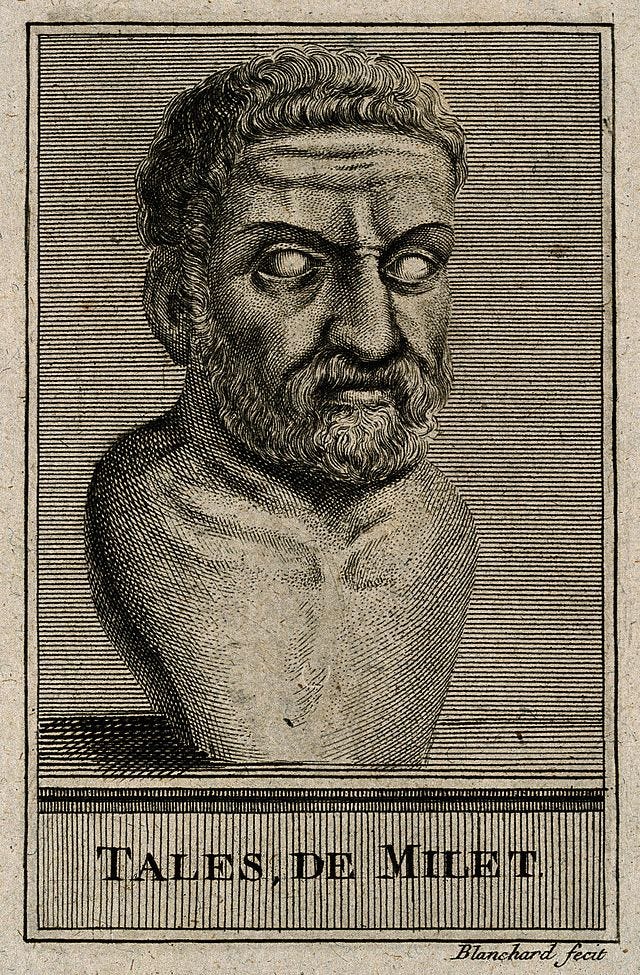
The Greek philosophers were the first to pursue philosophy, per se, for its own sake. Before, philosophy was confused with religion, as in the Hindu doctrines or in Buddhism, but now philosophy was freely pursued as a science, separate from religion.
The Physicists
The first Greek philosophers were called the Physicists, because their philosophies aimed to understand the behaviour of the world. Thus, these philosophers were focused on matter, which is to say, the sensible object of philosophy. Change was the phenomenon that most fascinated them:
Since the most universal and most important phenomenon of nature is change, especially the change by which one body becomes another (e.g. bread becomes flesh, wood fire), they concluded that the original matter of which all things are fashioned must be identical in all, the common subject of all corporeal changes. But since they were still unable to conceive any impalpable or invisible principle, they thought they had discovered this matter in some one of the elements perceived by the senses. (ItP)
Maritain states that these philosophers recognized the reality of change, as well as the reality that all matter was in some way alike, since all things can be transformed into all other things. Therefore, there must be some commonality between all types of matter. These philosophers perceived this commonality not as a metaphysical principle, but as sameness in matter.
Thus Thales of Miletus famously said that everything was made of water. Other philosophers followed, with Anaximenes saying that everything was made of air, Heraclitus fire, and Anaximander the “boundless, (by which he understood the indeterminate …), a fusion of all the contraries”. (ItP)
One problem arises with this theory: If, as Thales understood it, everything is derived from “the primordial waters” (ItP), why would the primordial waters change at all? Ditto for all the other philosophies. This is because, as Maritain states, whatever these elements were, they were always understood to be a vital, fecund force, thus causing change. This is the hylozoist philosophy because “it ascribed life … to matter”. (ItP)
This “materialistic monism which teaches the existence of a one [sic] single substance of a material nature” inevitably leads to pantheism, which is to say the identification of God with the universe, where in Aristotelian-Thomistic philosophy, God and the universe are distinct. It also leads to “evolutionism, which attempts to explain everything by an historic process of unfolding, development, or evolution of something pre-existent.” (ItP) Does this sound familiar?
The basics of Darwinian evolution were already being taught in the 6th Century before Christ, initially by Anaximander, but later by Empedocles, who Maritain says is an improvment in speculation compared to the others.
Empedocles:
explained the origin of living beings by the separate production of the individual organs and members, e.g. the head, eyes, arms, which were subsequently joined by chance in every possible combination, of which only those have survived which were fitted to live (cf. the Darwinian principle of the survival of the fittest) . (ItP)
As we shall see, the evolutionary account is more complex than that.
Heraclitus
Heraclitus was the greatest of the physicists because he alone articulated the problem of change through the errors he made in his heroic, but self-contradictory, philosophy. Heraclitus said that change was the only reality, because “change has no abiding and permanent subject identical with itself”. (ItP) Heraclitus famously said that you cannot step into the same river twice, because the subject was always changing. That “the very moment we touch an object, it has already ceased to be what it was before.” (ItP) This is called the doctrine of flux.
Heraclitus also held the doctrine of the unity of opposites. This is because, in his doctrine of change, he denied that a thing can be identical with itself, because that thing is always changing (the thing is both identical and not identical to itself). He therefore denied the Law of Identity. This means that opposites are the same since an attribute can both exist and not exist in a species at the exact same time.
Democritus
Democritus formalized the evolutionist doctrines of the previous physicists into his atomic theory. As Maritain says, in order to find something unchanging in Heraclitus’ flux, he used his imagination and imagined that being itself was divided into atoms, which interacted with each other in order to produce all phenomena. These atoms would be arranged in different ways in order to produce different materials. They would differ “only in shape, order and position.” (ItP) This philosophy is called atomism, but Maritain uses the term “mechanical” (ItP), since it is more precise.
In this fashion the Parthenon could be “explained” as the result of throwing stones one on another during an indefinite term of years (ItP)
Anaxagoras
Anaxagoras is interesting, because he determined, contra all the other physicists, that the material cause, which is to say the material composition of an object, is insufficient to explain it. (ItP)
We must also discover the agent that produces them (the efficient … cause) and the end for which the agent acts (the final cause). Is it, as Plato was to ask later, a sufficient explanation of the fact that Socrates is sitting in prison to say that he has bone, joints, and muscles arranged iin a particular fashion? (ItP)
In addition, for recognizing “a separate Intelligence … to which the ordering of the universe is due, he alone, as Aristotle remarks ‘kept sober’ when all the other philosophers of his period, drunk with the wine of sensible appearances, ‘spoke at random’1” (ItP)
Metaph., i, 3,984,b 18. [This is Maritain’s footnote]